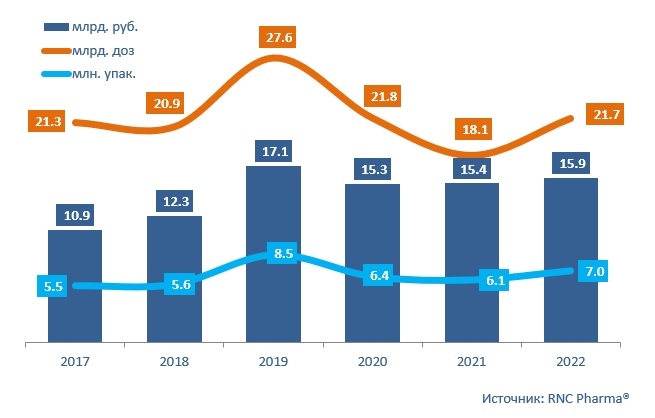
Statistics on the supply of foreign veterinary vaccines to Russia in 2022
RNC Pharma, an analytical company, provides information on the import activity of veterinary vaccines in Russia in 2022.
The total volume of foreign veterinary vaccines supplied to Russia (excluding shipments from EAEU countries) reached 15.9 billion rubles in 2022 (in prices including the cost of customs clearance, including VAT). Over the past three years, the monetary volume of supplies has changed minimally, with a 3.4% increase compared to 2021 (when calculations are made in rubles). Against this background, natural volumes grew quite actively, the dynamics in packages amounted to 14.9%, in total, about 7 million packages of vet were imported last year. vaccines. Deliveries were also actively growing during calculations in doses, where the increase reached 19.8% compared to 2021, and 21.7 billion rubles were shipped to the Russian market in just one year. doses of drugs for vaccinoprophylaxis in animals.
Despite the objectively more difficult conditions on the market in 2022, the market as a whole recovered from the lows of 2021, although it is still a long way from the levels of 2019. However, the surge in activity among foreign trade participants was not driven by objective demand factors, but rather by regulatory changes in the industry. The structure of vaccine supplies by type varied significantly, with live vaccines exhibiting the highest ruble-based dynamics, with a 10.8% increase in rubles compared to 2021, while the activity of suppliers of inactivated vaccines decreased by 2.7%, resulting in a slight increase in the volume of the former. In contrast, the supply of combined vaccines remained virtually unchanged (a 0.2% increase), but they accounted for less than 7% of the total supply.
There were also significant differences in the types of animals for which the vaccines were intended. Suppliers of vaccines for farm animals (FA) showed an increase of 7.3% (in rubles) compared to 2021. The total range of vaccines for productive animals decreased by 11 positions over the year, and in 2022, 93 vaccines from 17 corporations were shipped to Russia. In terms of ruble-based supply dynamics, the Eripesten drug from Czech Bioveta stood out (3.8 times higher than in 2021 in rubles), which is used to prevent erysipelas and classical swine fever. The second outstanding result was achieved by Innovax from American MSD (3.4 times higher), which is used to prevent Marek's disease, Newcastle disease, and Gumboro disease in birds.
At the same time, shipments of vaccines for pets (MJ) fell by 31.6% compared to 2021, and this negative trend has been observed for the third year in a row. The assortment of brands remained virtually unchanged, with 11 brands being shipped in 2022. The overall drop in supplies was almost exclusively due to problems with the import of Nobivac products from MSD. Over the course of the year, shipments decreased by 75% (in rubles), and it is interesting that while the product was shipped to Russia on a monthly basis in 2021, there were no shipments at all in March 2022, and the shipments in June, July, and October were purely symbolic. The maximum growth in the group of vaccines for non-productive animals was observed for Bioveta products, particularly Biofel (70-fold growth) and Biokan (2,059-fold growth), which effectively replaced certain products from the Nobivac line for cats and dogs that were experiencing supply difficulties.